Published 15 min readRhys Rowlands, Founder
EU and UK Early Career Data Roles Want AI Users
Data employers are shrinking routine analyst work while hiring juniors who can test AI outputs, govern data and explain uncertain results clearly

In this report
JobPing tracks 1474 live early-career data and analytics roles across the EU and UK as of 14 September 2026, but the safer junior profile is no longer simply dashboard builder. Employers increasingly want analysts who can use AI, inspect its evidence, catch weak outputs, and govern the data beneath it. The trap is replacing one narrow identity with another: adding prompt engineering to a CV without showing SQL, data quality, or business judgement. Build one credible workflow from messy source data to a checked recommendation, because neither prompt-only candidates nor dashboard-only generalists fit the role now taking shape.
The shift is visible across employer surveys, job adverts, and current junior vacancies. It does not prove that AI caused the contraction in entry-level data hiring. It does show that employers are changing what they expect from the people who remain close to the data: less routine production, more evaluation, delivery, and accountability.
The early-career data brief is changing
JobPing currently tracks 15992 early-career roles across the EU and UK, including 1474 in data and analytics. The useful conclusion is not that every graduate should become an AI engineer. Data applicants need to show where reliable analysis ends, where AI helps, and where human review must resume.
| Market measure | Live JobPing snapshot |
|---|---|
| All early-career roles across the EU and UK | 15992 |
| Data and analytics early-career roles | 1474 |
| Snapshot date | 14 September 2026 |
The data category covers more than one job family. Business analysts, reporting analysts, data consultants, junior data engineers, insight analysts, and analytics graduates may all appear beside roles closer to machine learning. Their technical depth differs, but their briefs increasingly overlap around a common question: can the candidate move from an output to a defensible decision?
A polished Power BI portfolio can still demonstrate useful craft. SQL and Python remain valuable. The weakness appears when the portfolio ends at "I built a dashboard" without explaining data provenance, missing values, access rules, test cases, model limitations, or what a stakeholder should do next.
That is also why 1474 live roles should guide targeting rather than trigger a scattergun application spree. Use JobPing matches to isolate genuine data roles in your chosen cities, then classify each description by the work it rewards: reporting, engineering, governance, experimentation, AI delivery, or some mixture of them.
The UK analyst mismatch is operational, not a funeral for SQL
The June 2026 GOV.UK and LinkedIn entry-level hiring snapshot reported UK Data Analyst hiring down 15%. Its sharper finding was zero overlap between ten shortage skills and ten commonly supplied skills. The report points to an experience and delivery mismatch, while explicitly stopping short of proving that AI caused the hiring decline.
The candidate-surplus list included Microsoft SQL Server, Power BI, Python, Tableau, analytics, SQL, data visualisation, data analysis, data science, and data modelling. Those are not useless skills. They are the foundation of many analyst jobs and frequently appear in screening criteria.
The shortage list described a different layer of work: data governance, data engineering, data quality, visualisation, data models, SAS, Google Cloud Platform, Alteryx, Microsoft Azure, and data manipulation. In plain terms, employers were struggling to find people who could make analysis dependable inside a working organisation, not merely reproduce the standard graduate toolkit.
There are two caveats graduates should keep attached to this evidence. First, the skills comparison covers all seniority levels within the occupations, not only entry-level posts. A student should not read "data engineering in shortage" as proof that every junior analyst vacancy expects production-platform ownership. Second, the report says AI-exposed occupations have experienced visible declines but that further research is needed before causal conclusions can be drawn.
The practical response is to keep SQL, Python, and dashboarding while adding evidence of operational maturity:
- document where a dataset came from and who may use it;
- write data-quality checks before analysis;
- show how a pipeline handles missing or duplicated records;
- explain why a cloud service or local process suits the task;
- record how an AI-assisted result was tested against source data;
- state what remains uncertain after the analysis.
A graduate cannot manufacture three years of production experience. A graduate can, however, stop presenting coursework as if clean CSV files descend from the sky.
Indeed and ISE show AI entering the ordinary analyst brief
Indeed Hiring Lab reported in August 2026 that 48.8% of UK data and analytics postings mentioned AI or related tools at the end of June. The Institute of Student Employers separately found that 87% of 144 employers expected AI to reshape graduate and apprentice roles. Applicants should prepare for changed tasks, not declare the occupation dead.
Indeed's measure covers the full UK data and analytics category rather than early-career vacancies alone. It also detects references to AI and related tools; a mention does not mean half of data analysts are now building foundation models. The number is still consequential because AI language has entered the mainstream vocabulary of the sector. Graduates who cannot discuss an AI-assisted analytical workflow may increasingly look less current than candidates who can.
The 2026 ISE Student Development Survey helps define what employers mean by readiness. Respondents expected critical thinking, AI literacy, communication, and adaptability to rise in importance, while routine administration, basic data tasks, and simple writing declined. Most anticipated reshaping rather than wholesale replacement.
That combination matters. AI literacy without critical thinking produces confident mistakes. Critical thinking without practical tool use can become abstract caution. Communication without technical evidence becomes a slide deck nobody should trust. The employable bundle is the ability to use a tool, challenge its result, and explain the remaining uncertainty to someone who did not build it.
ISE also found employers were almost twice as likely to develop digital literacy after hiring as to recruit for it. Graduates therefore do not need to impersonate senior machine-learning engineers. They need enough practical fluency to be trainable, paired with judgement strong enough not to create new risk on day three.
Eurostat puts data work underneath European AI adoption
Eurostat found that 20% of EU enterprises with at least ten employees used AI technologies in 2025, while 33% performed data analytics through their own employees. The figures describe different activities, but together they explain the hiring direction: AI adoption sits inside a larger organisational need to prepare, analyse, and control data.
The European Commission Joint Research Centre adds a second view. Its report on AI skills demand found job adverts referring to AI roles concentrated in AI and machine-learning engineering, data analysis, data engineering, and AI development. The overlap supports the idea that data work is becoming part of AI delivery rather than a separate reporting function.
The timeframe matters: the JRC job-advert evidence covers 2020 to 2023 and focuses on information and communications technology specialist occupations. It is not a live reading of the 2026 graduate market, and generative AI was still marginal in the education data discussed by the report. The study is useful for the structural connection between AI and data professions, not for claiming that every current analyst description contains the same terms.
For a graduate, the durable bet is the connective tissue: preparing trustworthy data, understanding a model's purpose, testing outputs, and translating evidence into a decision. Tool names will move faster than those responsibilities.
Talan shows what a junior AI and data hybrid looks like
Talan's current Junior AI and Data Consultant vacancy joins familiar analyst tools with AI delivery. The role names SQL, Python, PySpark, cloud platforms, dashboard creation, and the end-to-end data-science lifecycle, then adds hands-on AI plus foundational generative and agentic AI knowledge. Prompting appears inside the specification, not in place of technical delivery.
The work itself is equally revealing. Talan describes building AI solutions, preparing the data backbone for models, generating insights, and working with financial-services clients. The successful junior is not boxed into a dashboard corner or hired as a professional prompt writer. The job combines technical execution, lifecycle awareness, and communication.
A useful way to read this vacancy is as a stack:
- Data access: SQL and data manipulation retrieve and shape the evidence.
- Production tooling: Python, PySpark, and cloud familiarity move work beyond a local notebook.
- Communication: dashboards and client conversations turn analysis into a usable decision.
- Lifecycle thinking: the candidate understands what happens before deployment and after an output reaches users.
- AI fluency: predictive, generative, or agentic systems become another class of tools to apply and inspect.
Before mirroring such a description word for word, run the specific advert against CV Ping. The goal is to identify which parts of the stack your evidence supports and which claims would be empty keyword stuffing.
1,474 live early-career data and analytics roles across the EU and UK
Find data roles that value more than dashboards
Choose your career path and cities. Get 10 free matches, then test each shortlist against your CV.
Instant matches • No credit card • 2-minute setup
EU and UK data cities need side-by-side reading
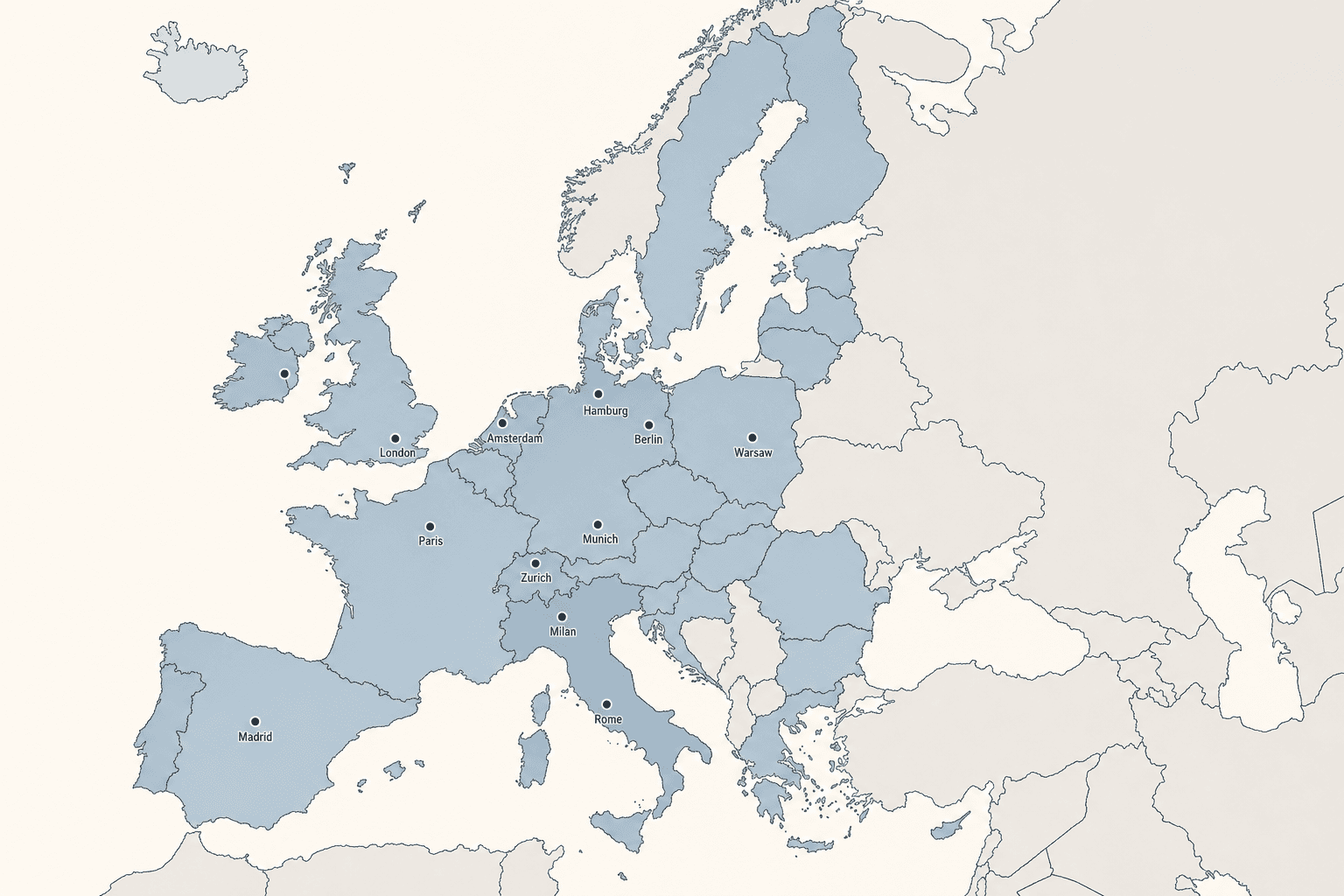
JobPing's city counts show where current data and analytics vacancies sit without turning a weekly snapshot into a permanent ranking. London has 240, Paris 118, Warsaw 114, Madrid 94, and Milan 94. Compare the live values, then investigate language, work rights, and employer type.
| City | Live early-career data and analytics roles |
|---|---|
| London | 240 |
| Paris | 118 |
| Warsaw | 114 |
| Madrid | 94 |
| Milan | 94 |
Snapshot: 14 September 2026. Counts reflect active early-career roles in JobPing's database.
A city count is a search-budget signal, not a promise of equal access. London applicants must distinguish open Graduate Route work rights from jobs offering Skilled Worker sponsorship. Paris vacancies often combine technical requirements with a French-language client or stakeholder filter. Warsaw includes shared-services and consulting operations where governance and cloud delivery can matter as much as model building. Madrid and Milan require the same advert-level reading for language, contract form, and work authorisation.
Weekly values can move, so the table deliberately avoids declaring a winner. The EU and UK graduate market overview supplies broader context, while the international sponsorship report covers candidates who cannot rely on local work rights.
Build one portfolio case across the AI lifecycle
A strong early-career data portfolio does not need six disconnected dashboards and a chatbot cloned from a tutorial. One compact investigation can show data preparation, analysis, AI-assisted work, evaluation, governance, and communication. The hiring advantage comes from making every decision inspectable, including the moments when the AI output was rejected.
Choose a question with a real decision attached. "Explore this dataset" is too loose. "Which support-ticket categories should a team prioritise next month, and how reliable is an AI-generated classification?" gives the analysis a user, a deadline, and a cost of error.
Then build the case in six parts:
- Define the decision and failure cost. State who will use the result and what happens if it is wrong. A false positive in a marketing classification is inconvenient; a false negative in a fraud or safety workflow may be unacceptable.
- Prepare and govern the data. Record the source, licence, fields removed, and assumptions made. Add checks for duplicates, missing values, invalid dates, and category drift. If personal data is present, explain how it was minimised or anonymised.
- Create a transparent baseline. Use SQL, Python, or a simple rules-based method before introducing AI. A baseline gives you something measurable to compare against and stops "the model produced an answer" from becoming the evaluation method.
- Apply AI to a bounded task. Classification, summarisation, or extraction is easier to assess than an open-ended assistant. Save prompts, model settings, and output versions. Do not send confidential or personal records to a public model merely to make the project look modern.
- Evaluate the output. Create a small human-reviewed test set. Inspect false positives and false negatives, not only an overall score. Note where the model fails by language, category, or input quality. If AI adds no useful improvement over the baseline, say so.
- Communicate a recommendation and control. Build the chart or dashboard only after the checks. Explain what action the stakeholder should take, what the model must not decide, and when a human should review the result.
That case demonstrates the skills implied across the GOV.UK, ISE, and Talan evidence: foundational analysis, data quality, judgement, AI literacy, and communication. It also gives an interviewer several defensible stories rather than one decorative screenshot.
Once the project is ready, use CV Ping against each target description to change emphasis honestly. A governance-heavy role may need the validation and access-control work near the top. A consulting role may need the stakeholder decision and communication. The project remains the same; the evidence order changes.
Turn data job descriptions into an application filter
Data graduates should treat each vacancy as a task map rather than a bag of fashionable nouns. Separate the requirements into foundations, operational data work, AI use, evaluation, governance, and communication. The resulting gaps tell you whether to apply now, tailor the evidence, or spend a week building one missing proof point.
Use a simple application check:
- Foundation: Can you show SQL, Python, statistics, or dashboarding in context?
- Operational work: Have you tested data quality, built a repeatable pipeline, or used cloud tooling?
- AI use: Have you applied an AI system to a bounded analytical task?
- Evaluation: Can you explain the baseline, test set, errors, and limitations?
- Governance: Can you discuss provenance, privacy, access, and human review?
- Communication: Did your analysis change or clarify a decision?
Do not wait until every box is perfect. Junior roles are meant to contain development. Apply when you can support the core requirements with evidence and can explain how you would close the smaller gaps. Skip roles whose junior label masks ownership of a mature production platform you have never encountered.
The same filter makes searching faster. Get free JobPing matches for data and analytics roles across selected cities, discard descriptions that are plainly senior, and sort the remaining roles by which portfolio evidence they reward. That is more precise than spraying the same Power BI CV across analyst, engineer, and AI-consultant vacancies.
The durable candidate identity is not AI expert. It is analyst who knows when and how to use AI, can test what comes back, and remains accountable for the recommendation. That claim is narrower, more credible, and closer to what the evidence says employers need.
FAQ
Is SQL still worth learning for an early-career data role? Yes. SQL appears in the GOV.UK and LinkedIn candidate-surplus list because many applicants already offer it, not because employers have stopped using it. SQL alone is less distinctive than it once was. Pair it with data-quality checks, pipeline thinking, governance, and a clear business decision to show that you can use it operationally.
Do graduates need machine-learning engineering skills to become data analysts? Not for every analyst role. Indeed's category-wide figure includes vacancies across seniority levels, and the JRC evidence focuses on information and communications technology specialist occupations. Graduates should understand where AI fits in an analytical workflow and how to evaluate it. Production machine-learning engineering is a separate depth of responsibility.
Did AI cause UK Data Analyst hiring to fall by 15%? The June 2026 GOV.UK and LinkedIn report does not establish that. It notes that declining occupations include roles where AI capability is visible, but says more research is required before drawing conclusions. The report also describes weaker general hiring conditions and an operational skills mismatch, both of which complicate a causal claim.
Is prompt engineering enough for a junior AI and data role? Usually not. Talan's current junior vacancy includes generative and agentic AI knowledge, but also asks for SQL, Python, PySpark, cloud familiarity, dashboards, lifecycle understanding, and client communication. Prompting is one technique inside a larger delivery process. A portfolio should show data preparation, evaluation, and controls around the prompt.
What should a graduate data portfolio contain now? One complete case is stronger than several disconnected screenshots. Include the decision, data source, cleaning and quality checks, a transparent baseline, a bounded AI task, human-reviewed evaluation, error analysis, governance choices, and a recommendation. State where the model failed and what requires human review.
Which European city should a data graduate target? Use the live counts for London, Paris, Warsaw, Madrid, and Milan as side-by-side indicators of current vacancy volume, not a permanent league table. Then filter by language, work rights, employer type, and the kind of data work advertised. The best target is a city where current roles fit both your evidence and legal access.
Sources
- JobPing database: 15992 active early-career roles across the EU and UK, including 1474 data and analytics roles; city values for London, Paris, Warsaw, Madrid, and Milan; snapshot 14 September 2026
- UK entry-level hiring and skills: GOV.UK and LinkedIn, A snapshot of entry-level hiring in the UK (8 June 2026)
- Graduate employer expectations: Institute of Student Employers, Entry-level work reshaped not replaced (2026 Student Development Survey, 144 employers)
- AI mentions in UK vacancies: Indeed Hiring Lab, 2026 Mid-Year UK Jobs and Hiring Trends Report (3 August 2026)
- EU enterprise adoption: Eurostat, Towards Digital Decade targets for Europe
- European AI skills demand: European Commission Joint Research Centre, AI skills supply and demand (job-advert data from 2020 to 2023)
- Current employer example: Talan, Junior AI and Data Consultant
- Related reports: AI Is Quietly Redrawing Who Hires Juniors in Europe, Across the EU and UK, Sponsorship Silence Is Default, Graduate CV Tailoring: One Generic CV Fails ATS
1,474 live early-career data and analytics roles across the EU and UK
Find data roles that value more than dashboards
Choose your career path and cities. Get 10 free matches, then test each shortlist against your CV.
Instant matches • No credit card • 2-minute setup
More to read
Related reports
Which Career Paths Are Hiring the Most Graduates Right Now
Marketing now carries more live EU and UK graduate roles than finance, while three mid-table paths sit close enough to swap places by next week's count.
Read reportEasy Apply or Career Page: Where Graduates Should Apply
ISE named Easy Apply as one reason graduate vacancies now draw 140 applications.
Read reportWhere New Graduates Are Finding Entry-Level Jobs in 2026
Most listings tagged 'entry-level' on LinkedIn and Indeed ask for two to three years of experience, so the filter matters more than the board.
Read report