Published 11 min readRhys Rowlands, Founder
Which Career Paths Are Hiring the Most Graduates Right Now
Marketing now carries more live EU and UK graduate roles than finance, while three mid-table paths sit close enough to swap places by next week's count
In this report
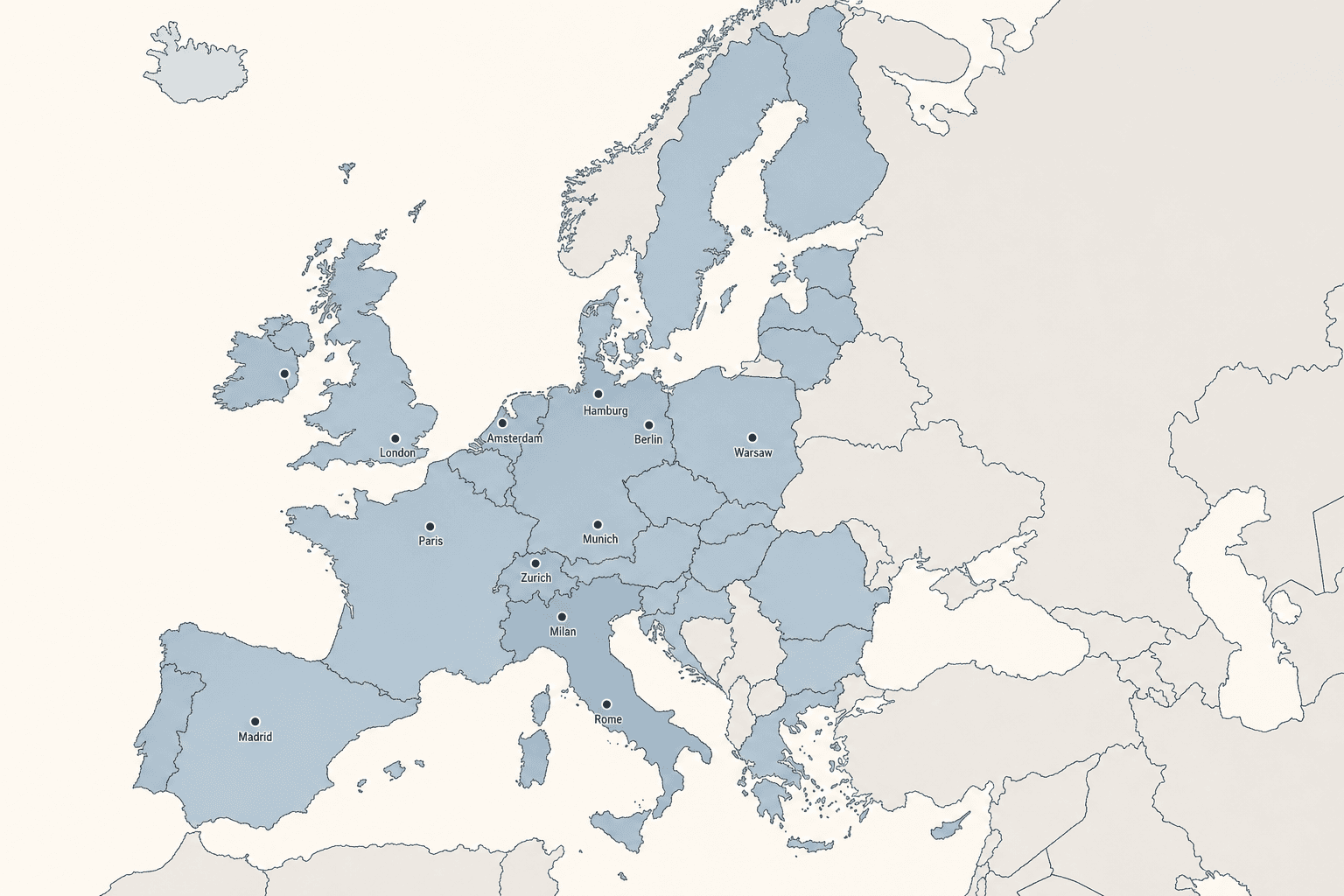
JobPing currently tracks 15992 live early-career roles across the EU and UK, split across nine career paths that most graduates never search by name. Marketing and growth roles now outnumber every other category, finance sits a clear second, and three mid-table paths - operations, strategy, and sales - are close enough in count that ranking them this month would likely be wrong by the next Monday refresh. The trap is picking a single job title to search ("marketing executive," "business analyst") instead of a career path, which discards the roles employers list under adjacent, less obvious names. Map the paths before you map the cities.
Most graduate job-search advice starts with a city or a famous employer. This report starts one step earlier: which of JobPing's nine career-path categories actually carry volume right now, which are close enough to treat as tied, and which are small enough that building a search around them alone is a bad bet. The EU and UK graduate market guide covers the country and city layer in full; this piece stays on the career-path layer underneath it.
Nine career paths, one very uneven distribution of live roles
JobPing classifies every early-career listing into one or more of nine career paths. As of 14 September 2026, the split is far from even - two paths carry nearly a third of the platform between them, three sit in a tight mid-table cluster, and two are small enough to require a wider search radius.
| Career path | Live early-career roles |
|---|---|
| Marketing and growth | 2905 |
| Finance and investment | 2398 |
| Operations and supply chain | 2247 |
| Strategy and business design | 2176 |
| Sales and client success | 2173 |
| Tech and transformation | 1931 |
| Data and analytics | 1479 |
| Sustainability and ESG | 352 |
| Product and innovation | 330 |
JobPing snapshot: 14 September 2026. Counts cover active early-career roles tagged to each career path out of 15992 total active listings; a role can carry more than one career-path tag, so the column is a demand signal, not a strict partition.
Marketing and growth is not "the biggest" because graduates are drawn to it - it is the biggest because the label spans brand, performance, content, CRM, social, and communications work that employers post under dozens of different job titles. A graduate searching only for "marketing graduate scheme" sees a fraction of what that row actually contains. The same widening applies to operations, which spans supply chain, logistics, business operations, and process roles that rarely share a job title either.
Read operations, strategy, and sales as a cluster, not a ranking. The three sit far closer together than the gap between finance and marketing above them - close enough that a single week's new postings and closures can reorder them. Treat "which of these three is biggest" as an unanswerable question this month, and instead notice that together they outweigh marketing and finance combined: a graduate who writes off operations, strategy, and sales as back-office work is ignoring the largest connected block of live hiring on the platform.
Two live comparisons already show what this looks like inside one city
The category split above is a platform-wide count. It says nothing about which city, employer type, or seniority band those roles sit in - and that is where the applicant-facing decision gets made. Two existing JobPing reports already do this at city level, and they are worth reading before you pick where to search.
Finance graduates get London jobs, Paris and Milan internships breaks the finance category down by city and contract type, showing that the same national total hides very different odds depending on whether you need a permanent contract or can take a stage. Berlin's early-career hiring machinery sends juniors into marketing does the same for the marketing category inside a single city, and finds that German-language fluency - not the English job title - is what actually filters the shortlist.
The pattern in both pieces is the same: a platform-wide category count tells you where to start looking, not where you will get hired. The finance role-family investigation and the data and AI investigation go a level deeper still, breaking their categories into sub-functions - insurance, risk, and treasury inside finance; governance, evaluation, and delivery inside data - because "finance roles" and "data roles" are themselves umbrella labels, exactly like marketing and operations above.
Build a two-path search instead of a one-title search
A single job title search misses roles that employers tag under an adjacent career path. The fix is mechanical, not motivational: pick two paths, not one, and let the platform's category filter do the widening that a keyword search cannot.
- Pick a primary path from the top five. Marketing, finance, operations, strategy, and sales together carry the large majority of live volume. Choose the one closest to your degree, internship, or project evidence.
- Pick an adjacent second path, not a random one. Data pairs naturally with marketing (analytics-led growth roles), finance, or tech. Strategy pairs with operations or finance. Sales pairs with marketing or client-facing tech roles. The adjacency should mirror work you can actually evidence, not a path you merely find interesting.
- Filter JobPing's free matching flow by both paths and your target cities, then read the first twenty results as a sample of what each path currently contains in practice - not as a list to apply to blind.
- Write one evidence file per path. A supply-chain project should read differently for an operations application than the identical project reads for a strategy application. Reusing one CV paragraph across both paths is the single most common reason a technically-qualified graduate gets filtered at the ATS stage.
- Run the exact job description against the exact CV version with CV Ping before submitting either path's applications, not after a rejection pattern has already formed.
- Re-check the category split monthly, not once. A path that was mid-table in September can move by November - not by an implausible amount, but enough to change where your second search effort is best spent.
The small categories are not yet a reliable landing zone on their own
Sustainability and ESG, and product and innovation, sit at the bottom of JobPing's nine career paths, together carrying only a small fraction of live early-career volume. Both are real categories with genuine listings inside them, but neither yet carries enough standalone graduate-scheme volume to build a search around on its own.
- Sustainability and ESG roles exist, but the graduate-specific door into them is still narrow. Most current listings sit inside a broader function - reporting, operations, or strategy - with an ESG or sustainability component attached, rather than a standalone graduate scheme built around the label. Treat ESG interest as an angle to bring into an operations or strategy application, not yet a search category on its own.
- Product and innovation is the smallest labelled path on the platform. Early-career product roles are genuinely scarce relative to the graduate interest they attract, partly because many employers still route product-adjacent junior hiring through tech or strategy postings instead of a dedicated product graduate scheme.
- Neither is a dead end - both are a signal to widen the search, not narrow it. A graduate set on sustainability work is better served filtering strategy and operations roles for ESG-relevant employers than waiting for a pure "sustainability graduate" listing to appear.
- This can change. Category volume is a snapshot of current employer posting behaviour, not a permanent ceiling; a category this small is also one where a handful of new graduate schemes can move the count meaningfully in a single quarter.
15,992 live early-career roles across nine career paths in the EU and UK
Filter by the career path that is actually hiring
Pick your top two paths and cities for 10 free matches, then test your CV against the exact listing with CV Ping.
Instant matches • No credit card • 2-minute setup
Counting roles is not the same as counting real opportunity
A career path with a high live count is not automatically the path with the best odds for any individual graduate. Volume tells you where employers are currently posting; it says nothing about visa sponsorship, seniority mix, or how many of those listings are genuinely open to a first job-seeker rather than requiring two years of experience under a "junior" title.
International graduates in particular should not read this table as "marketing is easiest" - sponsorship rates vary by sector and by country far more than headline role counts do, and a large category with a low sponsorship rate can be a harder search than a smaller category with a higher one. The international graduate visa sponsorship report covers that layer directly and should sit alongside this one, not instead of it, for anyone searching outside their home country. Run your two paths through JobPing's free matching flow with a visa filter switched on before you decide a category is worth the effort - the platform count and the sponsorship-filtered count for the same path are often very different numbers.
The other filter volume hides is application mechanics. A large category compresses into a small shortlist once you remove roles that are not genuinely entry-level, are closed but not yet delisted, or require a language or work-permit condition you cannot meet. That is exactly what testing each application through CV Ping is for: it will not change how many roles exist in a category, but it will tell you quickly which of the roles inside your two chosen paths are actually worth the time to tailor for.
The generic-CV failure mode described in why one CV kills every application gets worse, not better, the wider your career-path search becomes. Two paths means two different vocabularies, two different evidence sets, and - if you are doing it correctly - two different CV files. A single CV stretched across marketing and operations reads as competent at neither.
FAQ
Which career path has the most live graduate roles right now? Marketing and growth carries the most live early-career listings on JobPing, with 2905 roles out of 15992 tracked as of 14 September 2026. Finance and investment is a clear second. The next three paths - operations, strategy, and sales - sit close enough together that none of them can be reliably called the true third.
Should I only search the career path with the most roles? No. A higher count means more listings to filter, not necessarily better odds for you individually. Pair your strongest path with a second, adjacent one so your search widens instead of narrowing to a single job title, and check sponsorship, seniority, and location conditions inside each listing rather than assuming volume equals access.
Why do marketing and operations carry so many more roles than product or ESG? Marketing and operations are broad umbrella labels covering many distinct job titles - brand, content, CRM, and social under marketing; logistics, supply chain, and process under operations. Product and sustainability roles exist under narrower, more specific labels and are also more likely to be routed through a tech, strategy, or operations posting instead of a dedicated graduate scheme.
Do these career-path counts change often? Yes. JobPing's blog statistics refresh weekly. The two lead categories - marketing and finance - carry a large enough gap over the rest of the field that their order is unlikely to flip week to week, but the operations, strategy, and sales cluster sits close enough together that its internal order can and does move.
Can one job listing count toward more than one career path? Yes. A role that combines, for example, data work with a marketing function can carry both tags. Treat each career-path count as a demand signal for that path on its own, not as a share of a pie that must sum to exactly the platform total.
Is this the same data as the EU and UK graduate market guide? It draws on the same underlying JobPing database but reports a different metric - this piece uses the full active-listings count per career path, while the market guide's headline figure is a rolling seven-day window. Both are live and both are accurate; they simply answer different questions about the same market.
Sources
- JobPing database: 15992 active early-career roles across the EU and UK; career-path breakdown - marketing and growth 2905, finance and investment 2398, operations and supply chain 2247, strategy and business design 2176, sales and client success 2173, tech and transformation 1931, data and analytics 1479, sustainability and ESG 352, product and innovation 330; snapshot 14 September 2026
- Related reports: Graduate Jobs Across Europe and the UK, Bank Hubs Still Decide EU and UK Early Career Finance, EU and UK Early Career Data Roles Want AI Users, Finance Graduates Get London Jobs, Paris and Milan Stages, Berlin Early Career Hiring Sends Juniors Into Marketing, International Graduate Visa Sponsorship, Graduate CV Tailoring: One Generic CV Fails ATS
15,992 live early-career roles across nine career paths in the EU and UK
Filter by the career path that is actually hiring
Pick your top two paths and cities for 10 free matches, then test your CV against the exact listing with CV Ping.
Instant matches • No credit card • 2-minute setup
More to read
Related reports
EU and UK Early Career Data Roles Want AI Users
Data employers are shrinking routine analyst work while hiring juniors who can test AI outputs, govern data and explain uncertain results clearly.
Read reportEasy Apply or Career Page: Where Graduates Should Apply
ISE named Easy Apply as one reason graduate vacancies now draw 140 applications.
Read reportWhere New Graduates Are Finding Entry-Level Jobs in 2026
Most listings tagged 'entry-level' on LinkedIn and Indeed ask for two to three years of experience, so the filter matters more than the board.
Read report