Published 14 min readRhys Rowlands, Founder
Bank Hubs Still Decide EU and UK Early Career Finance
Banking-only searches miss the junior roles growing around money's operating systems, leaving graduates in the most crowded application queue
In this report
Across 2426 live finance and investment roles, junior hiring follows bank hubs but rarely stops at banks. Within 15992 active early-career openings on 14 September 2026, the finance board also contains insurance, risk, audit, treasury, fintech, and financial-data work. The trap is searching only for "investment banking analyst" in famous capitals. That discards the functions employers describe as difficult to fill and leaves graduates competing for the narrowest door. Choose two role families, map the hubs that employ them, and build evidence for the underlying work rather than the sector label.
The city question still matters, but this is not another contest between London, Paris, and Milan. The three-city finance comparison examines contract types, language, and internship access. This investigation follows a different trail: which finance jobs exist inside each hub, what qualifications open them, and why an insurer, central bank, audit practice, or payments company may offer a better first move than the bank logo every student recognises.
Early career finance is six labour markets sharing one label
Early-career finance divides into banking, insurance, risk, audit, treasury, and fintech or financial data. Each family hires for different evidence, follows a different calendar, and clusters around different employers. Graduates who treat finance as one occupation make their search broad while making every application vague.
| Role family | Typical junior work | Evidence worth showing | Employer cluster |
|---|---|---|---|
| Banking and markets | Credit analysis, valuations, trade support, client materials | Accounting fluency, market interest, modelling, concise writing | Banks, brokerages, asset managers, central banks |
| Insurance | Underwriting support, claims analysis, pricing, reserving | Numerical judgement, policy interpretation, customer or case evidence | Insurers, reinsurers, brokers, consultancies |
| Risk and compliance | Controls, operational risk, financial crime, regulatory reporting | Data checking, investigation, regulation, process discipline | Banks, insurers, payments firms, regulators |
| Audit and assurance | Testing balances, documenting controls, analysing evidence | Accounting, accuracy, stakeholder work, progress toward a qualification | Big Four, mid-tier firms, internal-audit teams |
| Treasury and corporate finance | Cash forecasting, funding, foreign exchange, budgeting | Excel, accounting, forecasting, commercial explanation | Corporate headquarters, banks, utilities, industrial groups |
| Fintech and financial data | Payments operations, product analysis, automation, reporting | SQL, Python or R, dashboards, data cleaning, financial-market knowledge | Payments firms, data vendors, digital banks, market infrastructure |
The live total of 2426 is useful because it confirms there is enough breadth to run parallel searches. The action is to create separate alerts for two families rather than one alert for "finance graduate." A risk CV should foreground controls and investigation. A treasury CV should foreground cash, forecasting, and business decisions. Neither file improves by borrowing an investment-banking paragraph.
Skills England's 2026 financial-services assessment supports the wider definition. It identifies digital, data, and risk capabilities alongside sector knowledge, with computing, economics, mathematics, and accounting or finance apprenticeships among the important education routes. The consequence is practical: a computing graduate with financial-data work and an accounting apprentice with strong systems exposure can both be credible finance candidates, but for different vacancies.
Bank hubs work because specialist employers gather around them
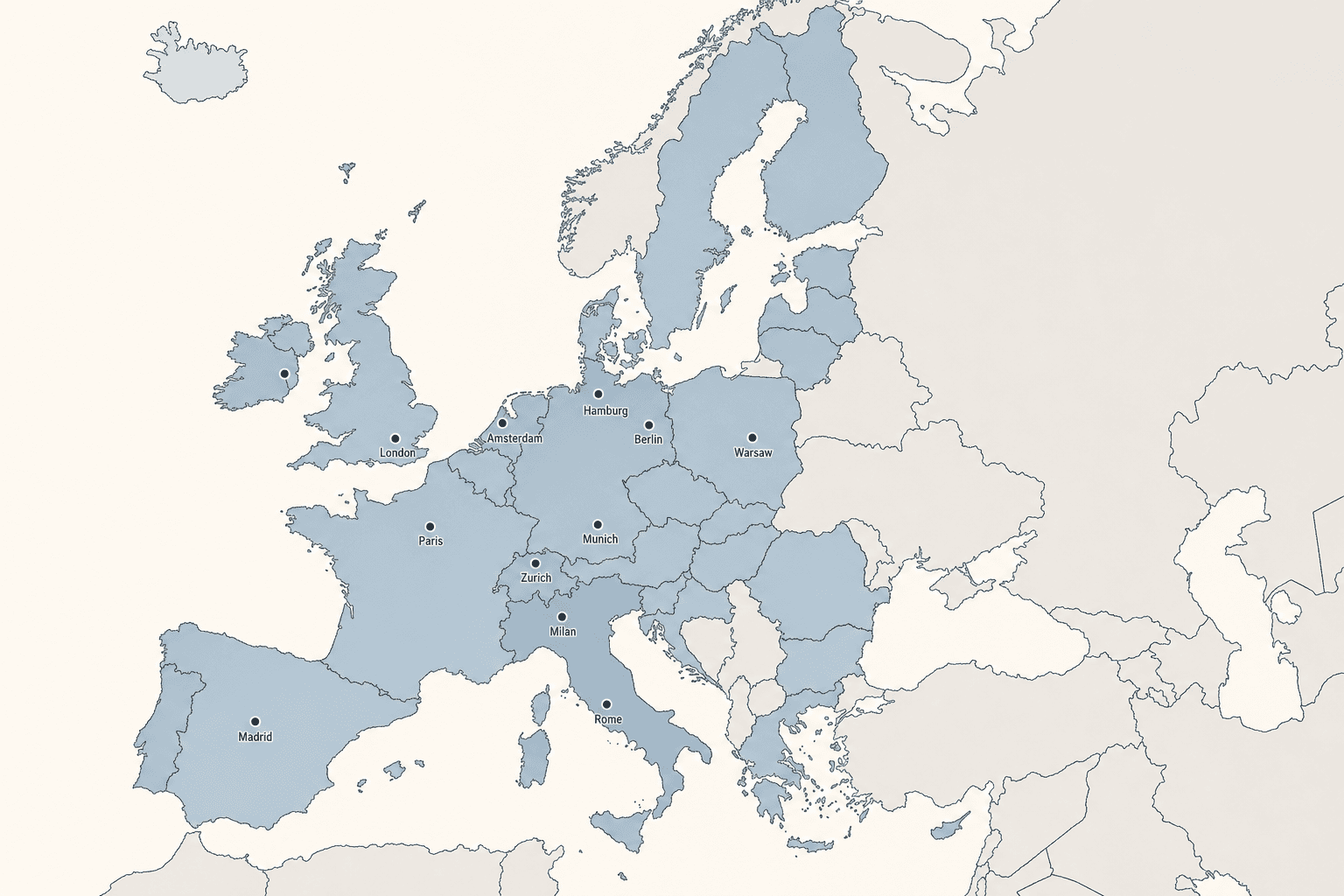
EU and UK finance hubs are employment systems, not rows of bank headquarters. Banks attract regulators, insurers, audit practices, data vendors, law firms, payments infrastructure, and corporate treasury teams. Junior candidates gain more from identifying that connected employer set than from asking which city wins a weekly league table.
JobPing currently records the following city boards side by side:
| Finance hub | Active finance and investment roles |
|---|---|
| London | 587 |
| Paris | 248 |
| Milan | 187 |
JobPing snapshot: 14 September 2026. Counts cover active early-career jobs tagged finance and investment; listings can carry more than one career-path tag.
Those values should set search effort, not produce a permanent ranking. Filter the live board again before each application week, then inspect which role families created the current volume. A bank internship cohort and a batch of audit vacancies may produce similar counts while requiring entirely different eligibility and preparation.
London connects banks and asset managers with the City insurance market, professional services, fintech, and finance teams inside large employers. Paris links universal banks with insurers, asset managers, regulators, and substantial corporate headquarters. Milan combines banking, wealth management, audit, insurance, and treasury around Italy's commercial centre. Frankfurt adds central banking, market operations, supervision, and German bank headquarters. Dublin and Luxembourg create routes through funds, custody, insurance, payments, compliance, and cross-border operations.
These clusters also have local friction. A Paris internship may require French and a university-backed convention de stage. London schemes may open early and send assessments soon after submission. Frankfurt central-bank work can ask for financial-market knowledge and technical data skills in the same vacancy. Search by role family and eligibility on JobPing's free matching flow, then keep only the hubs whose contract, language, and work-right conditions fit. A larger city list is worthless if half of it is administratively closed.
For the broader country and work-permit layer, use the EU and UK graduate market guide and the international sponsorship report. Finance can support international mobility, but a sector label never overrides a permit threshold or an employer's willingness to run the process.
Qualifications matter less than matching evidence to the function
Finance employers do not use one academic gate. Degree subject, apprenticeship training, postgraduate study, professional exams, and technical projects each carry weight in different role families. The better question is whether the qualification proves the work named in the vacancy, not whether it sounds prestigious beside the word finance.
Use the vacancy backwards:
- Banking, markets, and investment research: accounting, economics, finance, mathematics, and evidence of following markets can help. A technical degree becomes relevant when the candidate can explain valuation, credit, products, or market structure rather than merely listing coursework.
- Insurance pricing and analytical risk: mathematics, statistics, economics, actuarial study, and coding can travel well. Underwriting and claims can also reward structured judgement, communication, and the ability to interpret incomplete cases.
- Audit and assurance: accounting knowledge helps, but structured training routes often matter as much as the starting degree. Apprenticeship and professional-qualification pathways make audit one of the clearest alternatives to a conventional graduate scheme.
- Treasury and corporate finance: accounting, cash-flow understanding, forecasting, and commercial communication matter. Evidence can come from a placement, student society budget, small-business work, or a project that turned numbers into a decision.
- Fintech and financial data: computing, data science, engineering, economics, or finance can all fit when joined to SQL, Python or R, data cleaning, visualisation, and an understanding of the financial process being improved.
The European Central Bank's 2026 Graduate Programme sought 15 recent postgraduates across a wide field and valued experience in artificial intelligence or digital analytics, data management, econometrics, and visualisation. A cohort of 15 signals a selective route, so applicants should use the specification as a skills map rather than build an entire search around one programme.
The ECB's 2026 Market Operations traineeship made the combination even plainer: financial-market knowledge sat beside Python, R, SQL, data analysis, and visualisation. That pairing has a direct consequence. A coding project becomes stronger when it analyses rates, transactions, liquidity, pricing, or risk, while a finance project becomes stronger when the workflow is reproducible rather than a polished spreadsheet with no method.
Translate those requirements into the exact vacancy before submitting. Run the description and your role-family CV through CV Ping, then repair missing evidence rather than stuffing in synonyms. The generic CV investigation explains why one finance document tends to become bland enough for every desk and convincing to none.
Hiring optimism can coexist with a narrow junior intake
Financial-services employers can expect higher hiring while keeping graduate recruitment tight. Recent evidence points to demand for technology, data, and specialist finance capabilities, with apprenticeships carrying more of the early-career increase. Juniors should therefore follow the work being funded, not convert executive confidence into assumed graduate vacancies.
The Financial Services Skills Commission reported that combined apprentice and graduate intake among participating firms grew 2.5% in 2025, while graduate hiring fell 2% and apprenticeships drove the increase. The consequence is not that degrees have stopped mattering. It is that degree holders should search apprenticeship-style, trainee, analyst, and qualification-backed routes instead of waiting only for programmes labelled graduate.
The same report grouped difficult-to-fill work into technology-transformation roles and specialist positions including underwriting, claims, and pricing. That finding points applicants toward the edge of the traditional finance map. Insurance operations with analytical depth, risk technology, and pricing support may face a different candidate pool from investment banking, even when both sit in the same city.
KPMG's 2026 UK Financial Services Sentiment Survey questioned 150 director-level and senior leaders, with 55% expecting more hiring. KPMG also said planned recruitment concentrated in technology and artificial intelligence while early-career priorities lagged. Because the poll measures leadership intentions rather than confirmed junior vacancies, the applicant action is to search for funded technical work inside finance, then verify that the individual role is genuinely open to a first-job candidate.
Optimism at board level is weather. A vacancy with a junior grade, clear training, and an attainable specification is a door.
2,426 live early-career finance roles across the EU and UK
Search the whole finance system, not one famous desk
Match by role family, location, and eligibility, then tailor your CV to the work the employer is buying.
Instant matches • No credit card • 2-minute setup
Overlooked finance routes often teach the most portable work
Insurance, risk, audit, treasury, and financial-data roles are not consolation prizes for missing investment banking. They can teach regulated decision-making, accounting, controls, forecasting, coding, and client communication. Those capabilities travel across employers, while a famous employer name without intelligible work leaves a junior CV surprisingly thin.
A sensible overlooked-route shortlist has five lanes:
- Underwriting, claims, and pricing support. These roles sit close to revenue and risk decisions. Look for evidence requirements involving judgement, portfolio analysis, case handling, or quantitative pricing rather than dismissing every insurance title as administration.
- Operational, credit, and model risk. Risk teams turn regulation into decisions and controls. Candidates should show how they found an error, tested a process, investigated an exception, or explained uncertainty to someone who had to act.
- Audit, assurance, and controls testing. External and internal audit produce disciplined evidence work and exposure to multiple business processes. Check the professional qualification, study support, travel expectations, and client mix before comparing starting titles.
- Treasury and finance transformation. Corporate treasury handles liquidity, funding, foreign exchange, and cash visibility. Finance-transformation teams improve the systems around those decisions. Search large non-financial employers as well as banks because the work often sits inside a corporate headquarters.
- Payments, market infrastructure, and financial data. These employers connect institutions rather than sell familiar consumer products. Junior work can include reconciliation, transaction analysis, product operations, reporting, automation, and data quality. Learn the process first, then use technical tools to make it safer or faster.
The test is whether a route creates evidence you can explain after a year. "Supported the finance team" is weak. "Investigated payment breaks, identified recurring causes, and changed the reporting process" is legible across banking, fintech, treasury, and risk. Follow verbs, systems, and decisions, not prestige borrowed from the building entrance.
Build a two-family finance search before tailoring applications
A disciplined finance search starts with two compatible role families, three employer clusters, and a separate evidence file for each lane. That structure keeps the market wide without making the CV generic. It also reveals quickly whether eligibility, qualifications, or weak examples are causing the rejection pattern.
- Choose a primary and adjacent family. Banking can pair with credit risk; insurance pricing with data; audit with controls; treasury with finance transformation. The pair should share some evidence while remaining different enough to multiply the employer list.
- Map employers around the function. Include banks, insurers, audit firms, regulators, payments companies, data vendors, and corporate finance teams where relevant. Use free JobPing matches to check which combinations are live rather than building a static spreadsheet from famous-company memory.
- Write an evidence bank before a CV. For each example, record the problem, data or documents used, judgement made, result, and tool. Keep university projects if they prove the task. Remove modules that merely prove attendance.
- Translate the evidence twice. A Python project for fintech should emphasise cleaning, automation, and data quality. The same project for market risk should emphasise exposure, assumptions, validation, and communication. Facts can be reused; framing must answer the job.
- Check the application mechanism. Confirm language, work rights, student status, professional-study expectations, and assessment timing before tailoring. A brilliant file cannot repair an unavailable internship agreement or a role pitched several grades above junior.
- Test the exact file against the exact description. Use CV Ping after the eligibility check and before submission. If repeated applications fail before interview, change the role-family evidence or target level. Sending the same wording faster only produces cleaner rejection data.
Finance juniors do follow bank hubs, but they do not need to follow bankers into the same queue. The stronger route often sits one employer or one function away, where financial knowledge meets a shortage in data, controls, risk, or operations.
FAQ
Which finance roles should a graduate search for besides investment banking? Search credit and operational risk, underwriting, claims, pricing, audit, assurance, treasury, commercial finance, payments operations, financial data, and finance transformation. Pick two related families so your examples remain coherent while your employer list expands.
Do I need a finance degree for an early-career finance job? Not for every route. Skills England identifies computing, economics, mathematics, accounting and finance, and apprenticeships as relevant pathways into priority financial-services occupations. The degree or training route must still connect to the vacancy's work through credible projects, placements, or technical evidence.
Which technical skills help finance graduates most? The useful tool depends on the task. SQL, Python, R, data visualisation, and spreadsheet skills can strengthen market operations, risk, pricing, treasury, and fintech applications. Pair the tool with financial context; employers need evidence that you can analyse a real process, not a list of software names.
Are apprenticeships relevant to university graduates? Some programmes have eligibility restrictions, so check each vacancy. The wider signal matters: the Financial Services Skills Commission found that apprenticeships drove recent growth in early-career intake while graduate hiring declined slightly. Graduates should include trainee and qualification-backed routes in their search rather than relying only on annual schemes.
Does expected UK finance hiring growth mean more junior jobs? Not necessarily. KPMG's survey found positive hiring intentions among senior financial-services leaders, but planned demand concentrated in technology and artificial intelligence while early-career priorities lagged. Treat employer optimism as a clue about functions, then verify that each vacancy has a junior grade and realistic requirements.
Should I choose a finance city or a role family first? Choose the role family first, then identify hubs with the relevant employer cluster and contracts you can enter. City volume can guide effort, but banking, insurance, audit, treasury, and fintech roles inside one hub require different evidence and may recruit on different calendars.
Sources
- JobPing database: 2426 active finance and investment roles within 15992 EU and UK early-career openings; London 587, Paris 248, and Milan 187 finance roles; snapshot 14 September 2026
- Education routes and priority skills: Skills England, Sector Skills Needs Assessment: Financial services (updated 4 August 2026)
- Early-career intake and difficult-to-fill functions: Financial Services Skills Commission, Annual Skills Report 2026
- Postgraduate finance, data, and analytical requirements: European Central Bank, Graduate Programme 2026
- Market operations and technical requirements: European Central Bank, Traineeship in Market Operations
- UK employer hiring intentions: KPMG, UK Financial Services to Boost Hiring in 2026
- Related reports: Finance Graduates Get London Jobs, Paris and Milan Stages, Finance vs Consulting: 80 Hours Buys a Narrower Exit, Graduate CV Tailoring: One Generic CV Fails ATS, Graduate Jobs Across Europe and the UK
2,426 live early-career finance roles across the EU and UK
Search the whole finance system, not one famous desk
Match by role family, location, and eligibility, then tailor your CV to the work the employer is buying.
Instant matches • No credit card • 2-minute setup
More to read
Related reports
London, Paris or Milan: Where Finance Graduates Get Hired
London has the deepest finance board, while Paris and Milan route far more junior openings through internships that demand local language and timing.
Read reportWhen to Apply for Graduate Schemes Before They Fill
Investment banking applications open in August and fill as they arrive, so a fixed autumn deadline elsewhere is a different clock, not spare seats.
Read reportLondon Finance Pay Bands Predict Who Can Sponsor
London finance pays £32,000 to £65,000 at graduate level, and the firms topping that range are the same short list that will file Skilled Worker paperwork.
Read report