Published 15 min readRhys Rowlands, Founder
Where Do Most Internship Rejections Happen?
Getting the internship now costs roughly 101 applications apiece. The Institute of Student Employers puts conversion for people who already hold one at 50%.
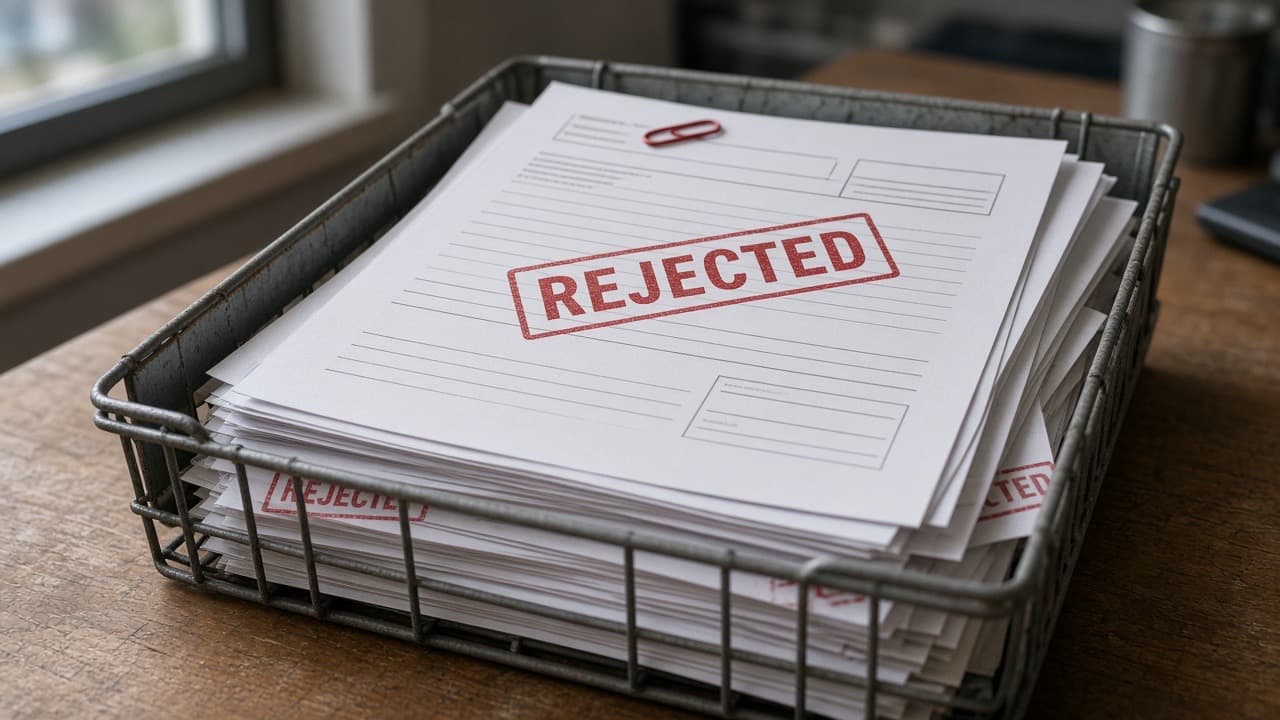
In this report
JobPing is tracking 15992 live early-career roles across the EU and UK this week (snapshot 14 September 2026), and the Institute of Student Employers puts UK internship-to-offer conversion at 50%, down from 54% a year earlier. Read only that number and rejection looks like a coin flip decided in the final interview. It is not. The same ISE survey found applications per internship vacancy climbed from 87 to 101 in a single year, and a candidate has to clear that seat before the 50% conversion rate ever applies to them. The trap is obvious once you see it: graduates spend the week before an assessment centre rehearsing answers, and the week after a rejection email assuming they talked themselves out of the room. Most of them were never close to the room. The volume math says the cut lands earlier, on the form and the test, and that is where the fix belongs too.
Internship Volume on the Live Board This Week
| What we track | Live figure |
|---|---|
| Active EU and UK early-career roles | 15992 |
| Snapshot | 14 September 2026 |
| UK roles that explicitly flag Skilled Worker sponsorship | fewer than 8% |
Counts are roles currently active in JobPing's database, sourced from employer career pages and boards we scan daily. The table shows the live board's size. It does not show any single employer's rejection stage, which is the question the rest of this piece answers from published survey data instead.
ISE Tracks Two Different Rejections, Not One Funnel
The Institute of Student Employers' 2025 Student Recruitment Survey, covering 175 UK employer respondents, reports two separate numbers that graduates routinely fold into one story: intern-to-offer conversion at 50%, and applications per internship vacancy at 101. The first measures what happens after you already have the internship. The second measures what it took to get it.
Keeping the two apart matters. Intern-to-graduate-offer conversion asks how many of last year's actual interns were offered a permanent graduate role at the end of their programme, and ISE puts that at 50%, down from 54% the year before, with undergraduate placement conversion down harder still, from 49% to 44%. Applications per internship vacancy asks how many applicants it took to fill that same seat in the first place, and that ratio rose from 87 to 101 in a single year - a 16% jump - while the placement ratio rose from 97 to 123, up 27%.
| Metric (ISE, 175 UK employers) | 2024 cycle | 2025 cycle |
|---|---|---|
| Applications per internship vacancy | 87 | 101 |
| Applications per placement vacancy | 97 | 123 |
| Intern-to-graduate-offer conversion | 54% | 50% |
| Placement-to-graduate-offer conversion | 49% | 44% |
Source: Institute of Student Employers, Student Recruitment Survey 2025.
So-what: these two numbers describe different stages of the same career, not the same stage twice. The 101 figure is the fight to become an intern. The 50% figure is the fight, once you already are one, to stay on past the programme's final week. You cannot average them into a single "internship rejection rate," and this article is honest about that gap: ISE has not published a stage-by-stage breakdown of the 101 that shows exactly how many die at CV screen versus online test versus interview. What it has published, alongside independent applicant-tracking data below, is enough to say with confidence which side of the interview most of that 101 disappears on.
Why Employers Are Moving the Cut in Front of the Camera
ISE's Claire Tyler, writing up the 2025 application-explosion briefing, names the mechanism directly: employers are "moving screening earlier in the process by introducing online assessments before video interviews, using automated threshold scores to decide which candidates progress, or only reviewing video interviews if candidates meet minimum criteria." That sentence describes graduate-scheme volume specifically, but ISE members run internships through the same recruitment machinery, often the identical applicant-tracking system and the identical numerical or situational-judgement test bank.
- ISE's companion AI survey found numerical reasoning tests are fully automated at 57% of member employers, situational judgement at 53%, and verbal reasoning at 49% - assessments with "clear scoring criteria," in ISE's own phrase, are the ones a machine now decides alone.
- Interpersonal stages stay almost entirely human: in-person interviews, group tasks, role play, and case studies sit at 94-100% human-led, the same survey found. Nobody has automated the room. They have automated everything that gets you to it.
- Graduate vacancies overall now draw 140 applications each, a 14% year-on-year rise, and two thirds of ISE members reported their own applications-per-hire climbing by at least 5% in 2025 - the same volume pressure that pushed the internship ratio from 87 to 101.
The honest reading is this: ISE has not published "X% of internship applicants are rejected at CV screen." What it has published is that the tests doing the heaviest, cheapest filtering across its member base are the automated ones, that those sit before the interview, and that the interview itself is barely touched by automation at all. A 101:1 applicant pool filtered mostly by machine before any recruiter opens a file is a very different problem than a 101:1 pool filtered mostly at a live assessment centre - and the mechanism ISE describes points squarely at the first. If your CV or test performance never got you flagged, the room where the interview questions live was never in play.
15,992 live early-career roles across the EU and UK this week
Match internships your CV can actually clear
Career path, city, and visa filter built in. 10 free matches on signup, then CV Ping before the online test lands.
Instant matches • No credit card • 2-minute setup
What Applicant-Level Tracking Data Shows, Hedged
The Trackr's 2025 Summer Internship Season Report, drawn from 213 self-selected UK finance and consulting applicants across 30 universities, is the closest published stage-by-stage breakdown available - and it should be read as community-platform data skewed toward one sector, not an ISE-grade audited sample. Treat the direction as useful and the exact percentages as one applicant pool's experience, not a universal law.
| Trackr metric (213 UK finance/consulting applicants, 2025 season) | Value |
|---|---|
| Average applications per respondent | 66 |
| Average interviews per respondent | 4.73 |
| Interview rate | 7.2% (down from 9.3% the year before) |
| Interview-to-offer rate | 18.7% (up from 15.8% the year before) |
Source: The Trackr, Summer Internships Season Report 2025.
Put the two rows side by side: getting an interview at all is the hard part, and it got harder year over year as the applicant pool grew faster than the interview slots did. Converting an interview you already have is the easier part, and it got slightly easier.
So-what: on this dataset, roughly 93 applications out of every 100 die before an interview is ever booked, while nearly one in five of the interviews that do happen end in an offer. If that pattern generalises even loosely beyond finance and consulting, rewriting the actual application - the CV, the keyword match, the online test prep - is where a graduate's time buys the most improvement, because it is the stage absorbing almost all of the rejection. Half of Trackr's respondents received zero offers all season, and the top 10% of candidates claimed 44% of them - a concentration that is easier to explain by application quality clearing the automated screen consistently than by 10% of students simply interviewing better once they arrived.
The Applicant Trap: Treating Every Rejection as an Interview Verdict
A graduate who gets a rejection email after applying to an internship almost always reads it as a verdict on themselves - their answers, their fit, their "polish." Given the volume math above, that reading is usually wrong. Most rejections at 101-to-1 odds are decided by whether a CV or online test cleared an automated threshold, not by anything a human formed an opinion about.
This produces a specific, correctable mistake: over-investing in interview rehearsal and under-investing in the document and the test that decide whether an interview happens at all. Assessment-centre and video-interview prep still matters once you are through, but polishing an answer to a competency question you will never be asked because the CV never cleared the keyword screen is time spent on the wrong 7%.
- If you have not been getting interviews at all, the honest diagnosis is the application stage, not your personality. Run the actual job description against your CV, not a generic version, and fix the keyword and formatting gaps an ATS is scoring before a person ever opens the file. Run the internship's job description through CV Ping before you submit, not after the rejection - free accounts get 3 full analyses, and Premium runs unlimited checks for €7/month alongside 15 weekly matches delivered Monday, Wednesday, and Friday.
- If you are getting interviews but no offers, the diagnosis flips. Trackr's 18.7% interview-to-offer rate is not a low bar, but it is not automatic either - that is the stage where assessment-centre and video-interview preparation earns its time back, because you have already proven the application clears the screen.
Large-Employer Internships Automate Harder Than the Mid-Market Ones
A structured internship at an ISE member bank or Big Four firm runs through the same numerical-reasoning and situational-judgement automation that screens its full graduate scheme, because the employer bought one testing platform and applies it across every entry route on the same applicant-tracking system. A ten-person operator hiring one summer intern usually has no such system, and the person reading your application is the same person who will interview you.
That split matters for where you spend an evening. A milkround-style internship at a household-name employer is the 101:1 pool ISE and Trackr both describe: automated test first, camera or live room second, and the CV needs to survive a machine before a person ever forms an opinion. A smaller employer's internship, sourced from JobPing's live board rather than a bank's graduate portal, more often skips straight to a conversation - which means the same CV that would die on an ATS keyword scan at a bank might get read in full by the person who will manage you. Neither route is "easier." They fail different people for different reasons, and conflating them is how a graduate tailors a CV for the wrong test.
Filter the live board by career path, city, and visa status before deciding which of the two funnels you are actually entering - a mid-market internship that reads your CV directly is a different application strategy than a bank programme that scores it by machine first, and JobPing's 10 free matches on signup make the split visible before you spend an evening writing to the wrong one.
How to Spend the Week You Would Otherwise Spend on Interview Prep
Redirect the hours a rejection makes you want to spend rehearsing answers into the stage that is actually filtering 93 applications out of every 100, and only shift back to interview prep once the application itself is proven to clear.
- Confirm which funnel you are in before you write anything. A recognised-brand internship almost certainly runs an automated numerical, verbal, or situational-judgement test; a small employer's posting on the live board more often does not. Get 10 free matches filtered by career path and city so you know which pile a given listing sits in.
- Tailor the CV to the exact job description, not to "internship" as a category. Run it through CV Ping against that specific posting - the keyword gaps it flags are the ones an ATS is scoring, and a generic CV fails this stage the same way at every employer that automates it.
- Practise the named test before you apply, not after an invite lands. If the posting names a provider (SHL and similar are common), sit a timed practice paper this week. A test failure looks identical to a CV failure from the outside: silence.
- Track where each rejection actually happened. No interview at all points at the application and test stage. An interview with no offer points at the room itself, where assessment-centre and video-interview prep is the correct investment.
- If you already hold an internship, do not wait for the final week to ask about conversion. The 50% and 44% ISE figures describe an average outcome, not a fixed ceiling - ask your manager in month one what a "yes" looks like in concrete terms, a question is-an-internship-worth-it covers in more depth for the decision of whether to accept the offer in the first place.
- Check sponsorship before you spend the evening. Fewer than 8% of UK early-career roles in JobPing's database explicitly flag Skilled Worker sponsorship. A perfectly tailored application to a non-sponsor still ends in the same silence, just later.
FAQ
Where do most internship rejections actually happen? Most of the volume attrition happens before an interview is ever booked, not during one. ISE reports 101 applications per internship vacancy in 2025, and interpersonal stages like in-person interviews stay 94-100% human-led while numerical, situational-judgement, and verbal tests are 49-57% fully automated. Trackr's applicant-level data, drawn from a smaller finance-and-consulting sample, puts the interview rate at roughly 7.2%, meaning the large majority of that 101 is filtered by CV screen or automated test before a person is involved.
Does the 101-applications figure mean my odds are 1 in 101? Not evenly. ISE's 101 is a vacancy-level average across 175 UK employers, and Trackr's data shows the split is uneven within any given pool: the top 10% of applicants in its sample claimed 44% of all offers. Your odds depend heavily on whether your CV and test performance clear the automated screen, which is a fixable variable, not a fixed lottery ticket.
What does the 50% intern-to-offer conversion rate actually measure? It measures a different question from the 101 figure. Once you already hold the internship, ISE found 50% of interns converted into a graduate-job offer in 2025, down from 54% the year before, with placement-to-offer conversion at 44%. That rate only applies once you have cleared the earlier, much harder cut to become an intern in the first place.
Should I stop practising for interviews and only tailor my CV? No, but reorder the effort. If you are not getting interviews at all, the application and test stage is the honest diagnosis, and CV tailoring is where the time buys the most improvement. If you are already reaching interviews and still not converting, Trackr's 18.7% interview-to-offer rate shows that stage is real too, and assessment-centre and video-interview prep is the correct next investment.
Is the online test the same for internships as for full graduate schemes? Often literally the same system. ISE members that automate numerical, verbal, or situational-judgement testing for their graduate scheme typically run interns and placement students through the identical platform, because building a second test bank for a smaller cohort rarely makes sense for the employer. Subject and degree-class filters can also apply before the test stage on some schemes.
How can I tell whether an internship still runs a human-read CV stage? You mostly cannot from the advert alone. As a rule of thumb, recognised large employers with a formal graduate scheme almost always automate the internship screen the same way; a small or mid-market employer posting directly rarely has the volume to justify buying that infrastructure. Get 10 free matches filtered by employer size and career path, then run the listing through CV Ping regardless of which pile it falls into - a tailored CV loses nothing at a human-read stage and gains everything at an automated one.
Sources
- JobPing database: 15992 live early-career roles across the EU and UK, snapshot 14 September 2026; fewer than 8% of UK roles explicitly flag Skilled Worker sponsorship
- UK internship and placement conversion, and applications per vacancy: Institute of Student Employers, 5 internship and placement trends to watch in 2026 (Student Recruitment Survey 2025, 175 UK employers)
- Screening moving earlier in the process: Institute of Student Employers, The application explosion: key insights for employers (140 applications per graduate vacancy, +14% year-on-year; automated threshold scoring before video interviews)
- Automation by test type and human-led interpersonal stages: Institute of Student Employers, How are employers using AI in early careers recruitment? (57% numerical / 53% situational judgement / 49% verbal fully automated; 94-100% human for in-person interviews, group tasks, role play, case studies)
- Applicant-level UK finance and consulting internship funnel (vendor/community sample, hedged): The Trackr, Summer Internships Season Report 2025 (213 respondents, 30 universities; 7.2% interview rate, 18.7% interview-to-offer rate, 1 in 75 applications led to an offer)
- Related reports: Does a University Internship Pay Off?, Easy Apply vs Career Pages for Graduates, Assessment Centres vs Video Interviews: What Wins?, Graduate CV Tailoring: One Generic CV Fails ATS, Can Your Degree Pass Graduate Scheme Screening?, EU Internships: When Graduates Should Apply
15,992 live early-career roles across the EU and UK this week
Match internships your CV can actually clear
Career path, city, and visa filter built in. 10 free matches on signup, then CV Ping before the online test lands.
Instant matches • No credit card • 2-minute setup
More to read
Related reports
Easy Apply vs Career Pages for Graduates
ISE named Easy Apply as one reason graduate vacancies now draw 140 applications.
Read reportWhich University Career Tools Help Graduates?
UK employers now field around 140 applications per graduate vacancy, the highest since 1991.
Read reportCan Your Degree Pass Graduate Scheme Screening?
An advert that says any degree welcome can still knock you out on your subject or grade once the online aptitude tests start screening.
Read report